Stop "Verschlimmbessern" Your Customer Success Strategy
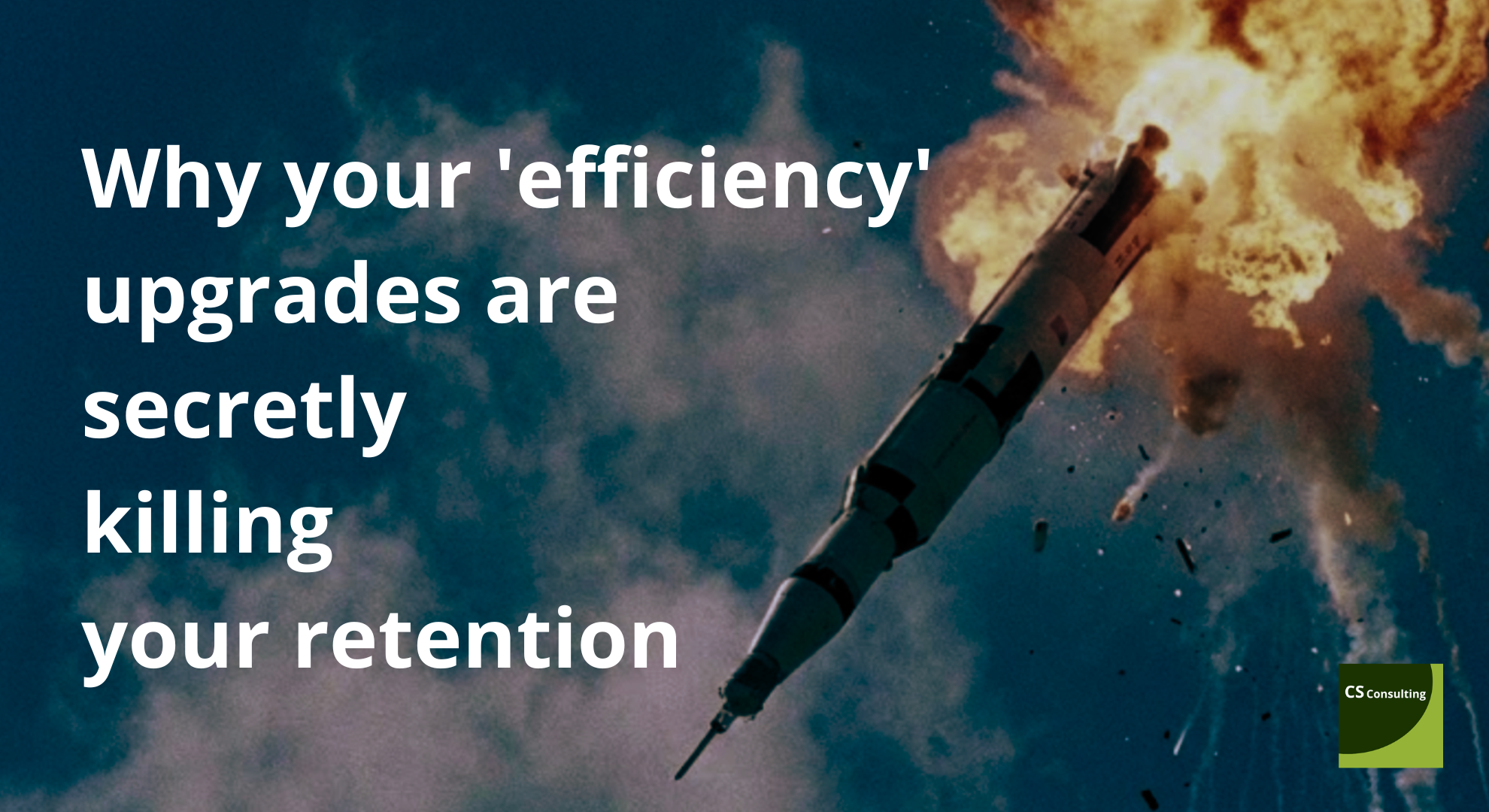
There is a wonderful German word that I find myself thinking about during one of my recent consulting engagements: Verschlimmbessern.
It translates to "making something worse whilst trying to improve it."
It describes those well-intentioned fixes that backfire spectacularly—like a software update that adds ten new features but makes the app impossible to navigate. It captures a failure born not of negligence, but of ambition.
As revenue leaders, we are operating in a pressure cooker. Investors have stopped being impressed by growth at all costs; they now demand efficient growth. You are likely feeling the heat to automate, to adopt AI, and to ensure your NRR climbs whilst keeping headcount flat.
The pressure to digitise the post-sales journey is immense. Leaders are terrified that if they don’t adopt the latest tech, they will be seen as outdated or replaceable. And often, digital transformation is exactly the right move. But I am seeing worrisome situations where the drive for internal efficiency is destroying external value.
The HR Learning Trap
I want to share a specific example that illustrates this perfectly.
I recently observed a company in the HR learning and development space. They were successful, but they hit that classic scaling ceiling. Their delivery model was heavy on human interaction—facilitated workshops, in-person cohorts, and high-touch management.
The leadership team did what any "smart" SaaS leadership team would do. They looked at the P&L, saw the low margins on services, and decided to pivot to a digital-first customer success model to fix their "leaky bucket".
They built a sleek platform. They automated the onboarding journey. They replaced the human facilitators with on-demand video content and replaced the Customer Success Managers’ check-ins with automated email flows.
On a spreadsheet, it looked brilliant. Margins improved immediately. Efficiency metrics skyrocketed. The board was thrilled—briefly.
Then the churn started.
It wasn't a slow leak; it was a deluge. When they finally dug into some exit interviews, they discovered the uncomfortable truth. The customers hadn’t been renewing because of the content of the training. They could get content anywhere. They had been renewing because of the connection.
They valued the peer-to-peer learning that happened in those "inefficient" human workshops. They valued the networking. They valued the specific, tailored advice a human CSM gave them during a coffee chat.
By "improving" the delivery mechanism—by making it faster, digital, and scalable—the company had inadvertently stripped away the primary value driver of their service. They had committed Verschlimbessern on an industrial scale.
The Dangerous Assumption
This happens because of a fundamental disconnect in how we define and research value.
Inside the boardroom, value often looks like speed, seamlessness, and "always-on" availability. We assume that if we give the customer a self-serve portal where they can get an answer in 30 seconds, they will be happier than waiting 24 hours for a call.
But often, customers don't want a portal. They want a partner.
The mistake the HR learning company made is treating value building as an internal operational decision rather than an external conversation.
They assumed that efficiency equals value. They were wrong. And as a result, they ended up with a customer base that felt unsupported and disengaged—the classic recipe for silent churn.
You Must Consult Before You Cut
I believe in the power of digital CS. I advise companies on how to scale their systems every day to reduce firefighting. But there is a right way and a wrong way to do it.
The wrong way is to let investor pressure dictate your customer journey.
The right way is to validate your assumptions before you change a single process. Before you replace a QBR with a dashboard, or a human onboarding specialist with an email sequence, you need to speak to your customers.
Ask them: "What is the one part of our service you would miss the most if we took it away?"
If the answer is "I’d miss brainstorming strategy with Sarah," and you fire Sarah to replace her with an AI bot, you are not scaling; you are churning.
Reflecting on the Pressure
I know why this happens. I have sat in the VP seat. I know the feeling of looking at a board deck and being terrified that your NRR story isn't defensible. I know the fear of being seen as the leader who didn't "get" AI.
It takes immense courage to tap the brakes on digital transformation and say, "Wait. We need to check if this 'efficiency' is actually what our customers are buying."
But that courage is what separates the leaders who build sustainable engines from those who just build faster ways to lose customers.
Join the Discussion
This is a complex topic, and one that is rarely discussed honestly because no one wants to admit their "improvements" failed.
I want to change that. I am opening a discussion thread on LinkedIn today to hear your stories.
I want to hear from two groups:
- Leaders: Have you ever implemented a change to scale or streamline operations that backfired? What did you learn?
- Customers: Have you ever been on the receiving end of a vendor’s "improvement" that actually ruined your experience?
Let’s have an honest conversation about the line between efficiency and value.